Key Takeaways
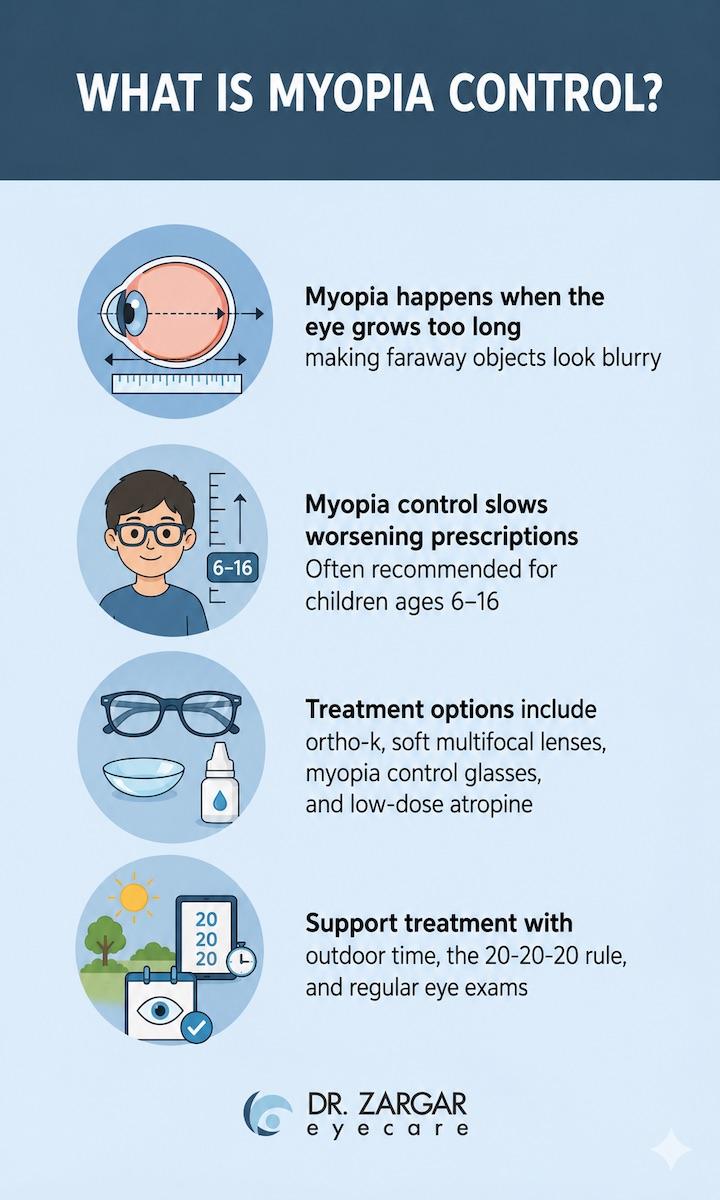
- Myopia happens when the eye grows too long, making faraway objects look blurry.
- Myopia control slows how fast a child’s prescription changes. It doesn’t reverse the condition.
- Treatment options include specialty contact lenses, myopia control glasses, and low-dose atropine drops.
- Most treatments are suited for children ages 6 to 16.
- Daily outdoor time and regular eye exams support long-term eye health.
Why Your Child’s Prescription Keeps Getting Worse
Your child passes their eye exam in first grade, gets glasses, and you think you’re done. Then their prescription changes again. And again. Is this how it always goes?
Myopia control is a range of treatments that can slow down how fast nearsightedness progresses in children, thereby helping to protect their future vision. At Dr. Zargar Eyecare, we help families in Richmond Hill navigate myopia control with management options tailored to children.
Myopia 101: What’s Actually Happening in Your Child’s Eyes
Nearsightedness, or myopia, happens when the eye grows slightly too long from front to back. Light that enters the eye focuses just in front of the retina, rather than directly on it. The result is that nearby objects look clear, while the far side of a classroom might look like a blur.
Most children with myopia first notice it before age 10. The condition tends to worsen through the teenage years as the eyes continue to grow.
What Myopia Control Actually Does
Regular glasses correct your child’s current vision, but they don’t do anything to slow down the changes to the eye that cause the condition to progress. Myopia control treatments work differently. They target the underlying mechanism (elongation of the eye) that causes myopia to get worse.
Myopia Control Treatment Options for Kids
Specialty Contact Lenses
Two contact lens options are commonly used for myopia control. Soft multifocal lenses like MiSight are worn during the day and are designed to reduce the signals that tell the eye to keep growing. Orthokeratology lenses, often called ortho-k, are worn overnight. They gently reshape the cornea so that your child can see clearly without having to wear lenses during the day.
We’ve written a blog post on the differences between daily myopia lenses and ortho-k lenses that can help you weigh your options.
Other Treatment Approaches
Contact lenses aren’t the right choice for every child. Specialty glasses like MiYOSMART and Stellest are designed for daytime wear and use the same peripheral defocus principle to slow eye growth. Low-dose atropine eye drops applied at night are another effective option. An optometrist can help determine which option makes the most sense for your child’s eyes.
When to Start and Who Myopia Control Is For
Most myopia control treatments are suited for children between ages 6 and 16, the years when the eyes grow the fastest. Starting earlier tends to produce better long-term results, because it gives us more time to slow progression while the eyes are still developing.
Children with rapidly changing prescriptions are often the best candidates for treatment. Family history matters too. If one or both parents are nearsighted, the chances of myopia developing and progressing more quickly in children go up significantly. That’s worth flagging early so a plan can be in place before the prescription climbs.
Even children who already have moderate myopia can benefit from starting treatment. The goal isn’t just slowing change going forward, it’s protecting their eyes from the higher long-term risks that come with stronger prescriptions.
Everyday Habits That Support Myopia Management
Treatment works best when it’s paired with supportive daily habits. We recommend the following:
- Aim for about 2 hours of outdoor time each day. Natural light plays a role in healthy eye development.
- Break up long stretches of screen time and close reading with regular visual breaks. We recommend the 20-20-20 rule: every 20 minutes, look at something 20 feet away for 20 seconds. This gives your eyes a chance to rest.
- Keep up with scheduled eye exams, so that your optometrist can track changes in eye growth, not just prescription.
These habits don’t replace clinical treatment, but they do support it. Think of them as a daily practice that keeps everything else working more effectively.
Take the Next Step for Your Child’s Vision
Myopia doesn’t have to be something you just accept. There are real options that can help slow the process down, starting now.
Our team at Dr. Zargar Eyecare works with families across Richmond Hill to create myopia management plans for children. Dr. Zargar is a member of the American Academy of Orthokeratology & Myopia Control, with specialized training in the management approaches that help slow myopia progression.
Contact us today to book an eye exam and find out which treatment approach fits your child’s needs.